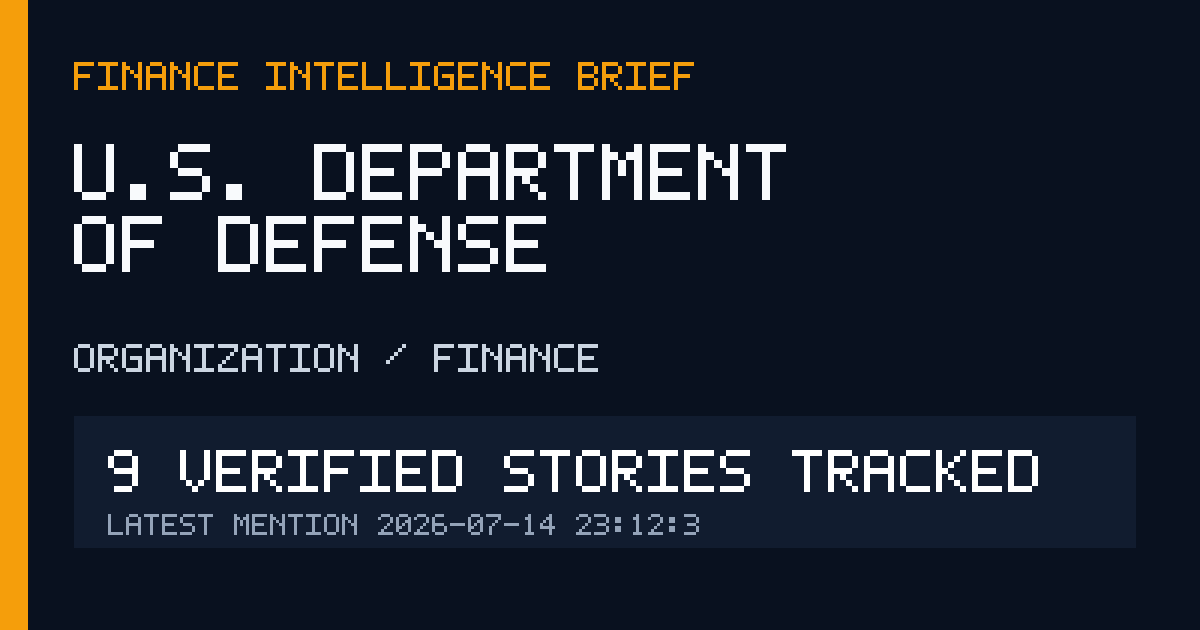
Negative sentiment reaches 44% here, compared with 29% across the 3237-story beat baseline for the same window. Donald Trump is the most frequent co-covered peer, appearing in 4 of the 9 tracked stories. The 7.3 average consequence score is above the beat benchmark of 6.3 in the same window.
Figures are computed live from our source-verified story record
— see our methodology for how impact and
sentiment are derived.
What the coverage shows about U.S. Department of Defense
Negative sentiment reaches 44% here, compared with 29% across the 3237-story beat baseline for the same window. Donald Trump is the most frequent co-covered peer, appearing in 4 of the 9 tracked stories. The 7.3 average consequence score is above the beat benchmark of 6.3 in the same window. The 161-day window averages about 0.4 stories each week. The busiest single day carried 3. They are corroborated in line with the beat average, carrying 2.8 original sources each against 2.8 for the same window. The clearest coverage concentration is markets: 5 of 9 stories, with the rest divided among 2 other categories. We currently track 9 Finance stories that mention U.S. Department of Defense, published between March 1, 2026 and August 8, 2026.
Stories tracked
9
Per week
0.4
Negative
44%
Sources per story
2.8
Computed from the 9 stories linked to this entity, with beat comparisons drawn from all 3237 Finance stories published in the same date window. Shares are omitted below five stories and comparisons below a twenty-story baseline.
Coverage cohort
Appears alongside
Other entities that clear the same relevance threshold in stories also covering U.S. Department of Defense. Shared-story counts are live from our verified record — not editorial picks.
The conditional $400 million loan to Sunrise Energy Metals from the US Department of Defense injects new momentum into critical mineral markets. The deal, backed by Lockheed Martin's offtake, is expected to stabilize scandium prices and attract further institutional investment.
House Republicans push through a $95B budget resolution funding the Iran war and tariff relief for farmers, adding directly to the deficit. The move signals sustained high defense spending and potential bond market pressure.
Alibaba stock fell 2.3% following its lawsuit against the Pentagon, highlighting investor anxiety over the blacklist’s chilling effect on US capital market access and advisory networks. With 188 firms now designated, markets weigh legal relief prospects against escalating US-China tech decoupling.
The initial six days of military conflict between the United States and Iran have incurred a staggering $11.3 billion in direct costs for Washington. This rapid expenditure highlights the massive fiscal burden of a modern high-intensity conflict and its potential to disrupt global economic stability.
A group of Democratic US senators has called for emergency hearings regarding the legal and strategic basis for military actions against Iran. The move highlights growing political friction in Washington over the War Powers Act and the potential for a broader regional conflict to destabilize global energy markets.
Iranian Foreign Minister Abbas Araghchi alleges that the first week of President Trump’s renewed military campaign against Iran has cost the U.S. treasury $100 billion. The claim follows a series of high-intensity strikes and a massive naval buildup in the Persian Gulf that has destabilized global energy markets.
Lockheed Martin has announced a massive scale-up of its munitions production, aiming to quadruple output to meet surging global demand. This strategic pivot comes as geopolitical conflicts in the Middle East and Eastern Europe signal a long-term shift in defense procurement and industrial capacity.
Major US defense contractors have reached a landmark agreement with the Trump administration to quadruple the production of high-end, 'exquisite-class' weaponry. This massive industrial pivot aims to replenish domestic stockpiles and bolster global deterrence amid escalating geopolitical tensions.
A newly created account on the decentralized prediction platform Polymarket secured a profit exceeding $515,000 by correctly wagering on a U.S. military strike against Iran. The high-stakes win highlights the growing influence of prediction markets in forecasting geopolitical volatility and raises questions regarding potential insider activity or high-conviction institutional trading.
U.S. Department of Defense is linked from 9 stories on this site, each scored at or above our 35% relevance threshold — see how these pages are built.
See something wrong on this page — a misattributed entity, a wrong stat, a broken source
link? Report a data issue.